
Starlink V5 power consumption is one of the biggest reasons the new terminal matters. For caravans, 4WDs, motorhomes, boats, remote sheds, baches, farms and off-grid sites in New Zealand, the difference between 35–50 W and 75–100 W can change the whole battery and solar calculation.
For New Zealand customers, this is especially relevant for baches, farms, rural properties, touring vehicles and off-grid sites where solar recovery and battery reserve can be limited by weather and travel patterns.
This guide explains what the published Starlink V5 power range means in practical terms, how it compares with Starlink Mini and Gen 3 / V4 Standard, and what to think about before building a 12V or 24V Starlink setup.
Quick answer: how much power does Starlink V5 use?
The SpaceTek V5 mobile brochure and Starlink-published specifications list Starlink V5 average power consumption at 35–50 W. That is higher than Starlink Mini’s 25–40 W range, but far lower than the previous Gen 3 / V4 Standard terminal at 75–100 W.
For planning purposes, a simple midpoint estimate puts Starlink V5 at around 42.5 W. Over 12 hours that is about 510 Wh. Over 24 hours that is about 1.02 kWh, before allowing for power conversion losses, router load, cable losses, snow-melt/heater behaviour or other connected equipment.
Starlink V5 power comparison
| Terminal | Published average power range | Midpoint estimate | Approx. 12-hour use | Approx. 24-hour use |
|---|---|---|---|---|
| Starlink Mini | 25–40 W | 32.5 W | 390 Wh | 780 Wh |
| Starlink V5 | 35–50 W | 42.5 W | 510 Wh | 1.02 kWh |
| Starlink Gen 3 / V4 Standard | 75–100 W | 87.5 W | 1.05 kWh | 2.10 kWh |
The practical takeaway is simple: Starlink V5 is much closer to Mini than to Gen 3 / V4 Standard. If you are sizing batteries or solar for a vehicle or remote site, that is a major improvement.
Why power matters so much in New Zealand installs
In a New Zealand house with grid power, Starlink power draw is usually not the biggest issue. In a caravan, 4WD, motorhome, boat, mine vehicle, farm shed or off-grid cabin, it matters every day.
Lower power draw can mean:
- less battery capacity needed for overnight use,
- less solar required to recover during the day,
- less inverter or converter heat,
- longer runtime during cloudy weather,
- less need to run a vehicle, generator or mains charger, and
- more margin for routers, cameras, laptops, fridges and other loads.
That is why Starlink V5 is interesting even if its quoted peak hardware speed is slightly lower than Gen 3 / V4. For many off-grid customers, the power saving is more useful than chasing a headline speed number.
12-hour and 24-hour battery examples
Using the 42.5 W midpoint, Starlink V5 needs roughly 510 Wh for 12 hours and 1.02 kWh for 24 hours. In a real installation, you should add margin for conversion losses and other network gear.
| Runtime target | V5 dish estimate only | With 15% system margin | With 25% system margin |
|---|---|---|---|
| 6 hours | 255 Wh | 293 Wh | 319 Wh |
| 12 hours | 510 Wh | 587 Wh | 638 Wh |
| 24 hours | 1.02 kWh | 1.17 kWh | 1.28 kWh |
These are planning estimates, not guaranteed consumption figures. Actual results can vary with satellite conditions, network activity, temperature, router choice, cable length, voltage drop and power supply design.
12V / 24V setups: why V5 is different from Mini
Starlink Mini is DC-native. It is designed around portable use and supports 12–48 V DC input. That makes Mini the simplest choice if you want a compact system that can run directly from a suitable DC source.
Starlink V5 is different. It does not have the same all-in-one, DC-native design. A V5 install needs the right power conversion and networking plan. That is not necessarily a problem, but it means customers should design the system properly rather than assuming V5 behaves like Mini.
Where StarPower V2 fits
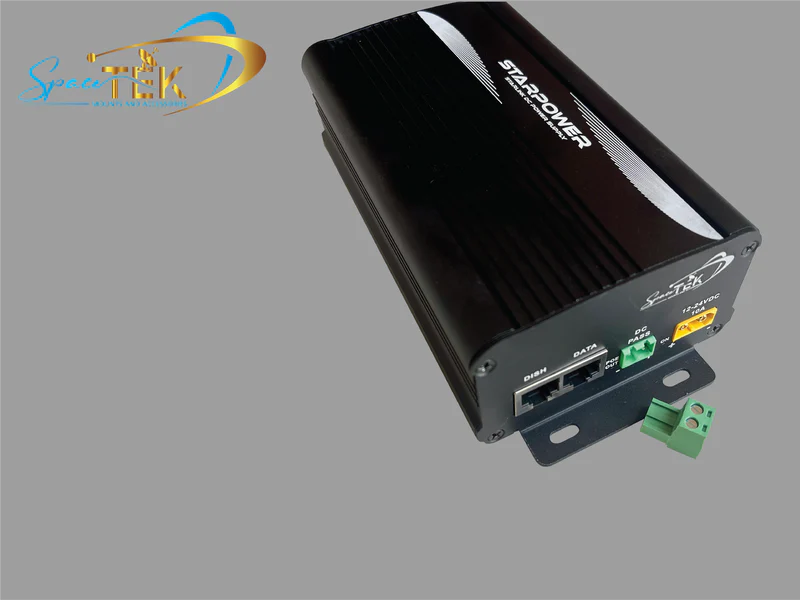
SpaceTek has tested Starlink V5 with the StarPower V2 12V / 24V DC power solution for compatible mobile installation use cases. This is relevant where the customer wants to power Starlink from a vehicle or battery system and use their own router or network equipment.
Starlink V5 should not currently be treated as Starlink’s dedicated in-motion terminal. SpaceTek’s position is more practical and conservative: V5 is not currently intended for in-motion use by default, however SpaceTek testing has demonstrated that mobile use can be feasible with the right Starlink plan, a suitable mount, correct DC power design and a properly configured network.
That combination is especially interesting for caravans, motorhomes, 4WDs, work vehicles and remote systems where an integrated Starlink Wi-Fi setup is not the best fit. It lets the Starlink terminal become part of a broader vehicle or site network, while still making clear that plan support and Starlink’s current terms must be checked before relying on it while moving.
Important: customers should confirm the full setup before installation, including the specific Starlink hardware, service plan, cable requirements, router choice, mounting, power supply and current Starlink terms.
Inverter vs DC power conversion
Many caravan and vehicle systems can run an AC inverter, but using an inverter for Starlink can add avoidable conversion losses. Battery power may be converted from DC to AC, then back into the DC/PoE power the Starlink hardware needs.
A well-designed DC solution can be more efficient and cleaner, especially in vehicles where the rest of the system is already 12V or 24V. The correct approach depends on the Starlink model, required voltage, cable length, protection, router choice and whether the installation needs to be serviceable by an installer later.
Do not size the system from average watts alone
Average wattage is useful for estimating runtime, but it is not the whole design. A reliable mobile or off-grid Starlink install should allow for:
- startup and short-term spikes,
- voltage drop over long cable runs,
- router, switch or access point power draw,
- fuses, breakers and cable protection,
- heat, vibration and water exposure,
- future servicing, and
- Starlink firmware, plan or hardware changes.
Best-fit V5 power use cases
- Caravans and motorhomes: roof-mounted V5 with a dedicated router and battery-backed DC system, where the Starlink plan and installation are suitable for the intended use.
- 4WD canopies and touring vehicles: compact terminal with a more permanent power and cable-routing setup.
- Commercial vehicles and fleets: Starlink integrated into a managed router, telemetry or failover system.
- Remote sheds and off-grid sites: lower daily energy use than Gen 3 / V4 while keeping separate networking.
- Events and emergency comms: deployable internet where battery runtime and compact hardware matter.
SpaceTek recommendation
If the priority is the lowest possible power draw and simplest portable DC setup, Starlink Mini is still the easy answer. If the priority is a more permanent install with your own router and a lower-power Standard-class terminal, Starlink V5 deserves serious consideration. For moving-vehicle use, the tone should remain cautious: V5 is not currently intended as the default in-motion choice, but SpaceTek testing shows it can be feasible when the Starlink plan, mounting, power and network setup are all right.
For New Zealand buyers, the real question is not just “how many watts does V5 use?” It is “how will the whole system be powered, mounted, routed and networked?” That is where the right accessories and installation plan matter.
Start with SpaceTek’s Starlink V5 mounts and accessories, compare Starlink 12V power accessories, or review the StarPower V2 if you are planning a V5 setup with your own router and DC power system.
FAQ: Starlink V5 power consumption
How many watts does Starlink V5 use?
Starlink V5 is listed at 35–50 W average power consumption. Real-world use can vary, so battery and solar systems should be sized with margin.
Is Starlink V5 lower power than Starlink Gen 3 / V4?
Yes. Starlink V5’s published 35–50 W average range is much lower than the Gen 3 / V4 Standard range of 75–100 W.
Is Starlink V5 lower power than Starlink Mini?
No. Starlink Mini’s published average range is lower at 25–40 W. V5 is close enough to be interesting for off-grid installs, but Mini still wins for lowest power and simplest portable DC input.
Can Starlink V5 run from a caravan battery?
It can be part of a battery-backed caravan or vehicle setup when the correct power solution is used. V5 is not currently intended as Starlink’s default in-motion terminal, however SpaceTek testing has demonstrated that mobile use can be feasible with the right Starlink plan, StarPower V2, suitable mounting, correct cable routing and an appropriate router/network setup.
How much battery do I need for Starlink V5 overnight?
Using a simple 42.5 W midpoint estimate, V5 needs about 510 Wh for 12 hours before system losses. A real installation should add margin for conversion losses, router power, cable length and other loads.
Technical note: Figures in this article are based on Starlink-published specifications and SpaceTek’s Starlink V5 mobile brochure. They are planning estimates, not guaranteed power-use figures. Starlink hardware, service plans and firmware behaviour can change.

Leave a comment
This site is protected by hCaptcha and the hCaptcha Privacy Policy and Terms of Service apply.